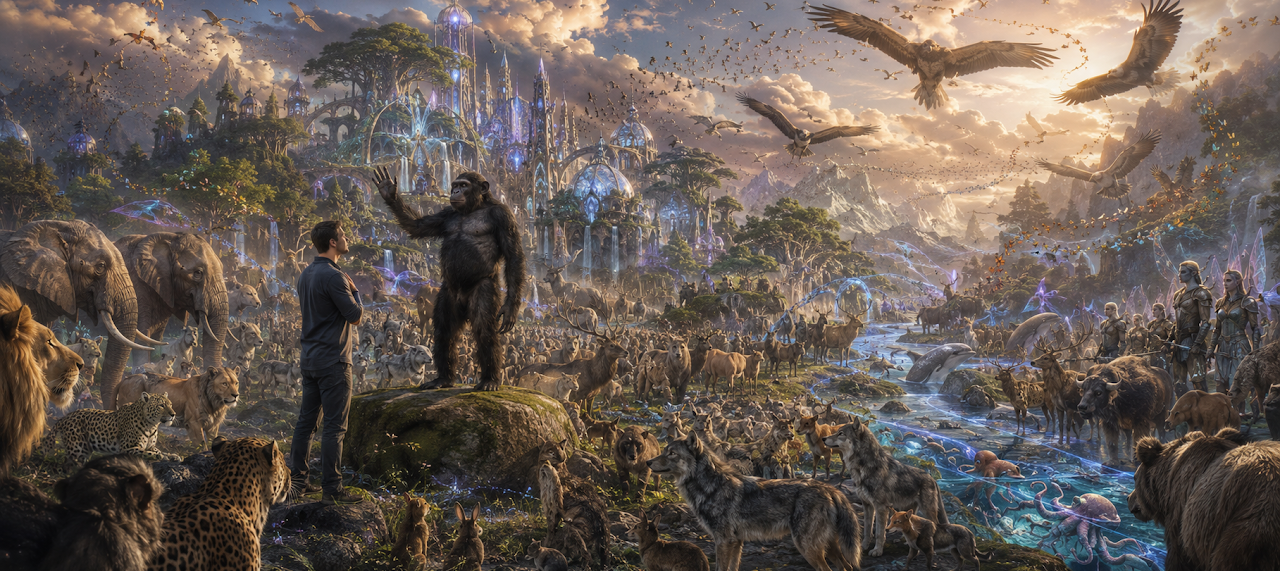
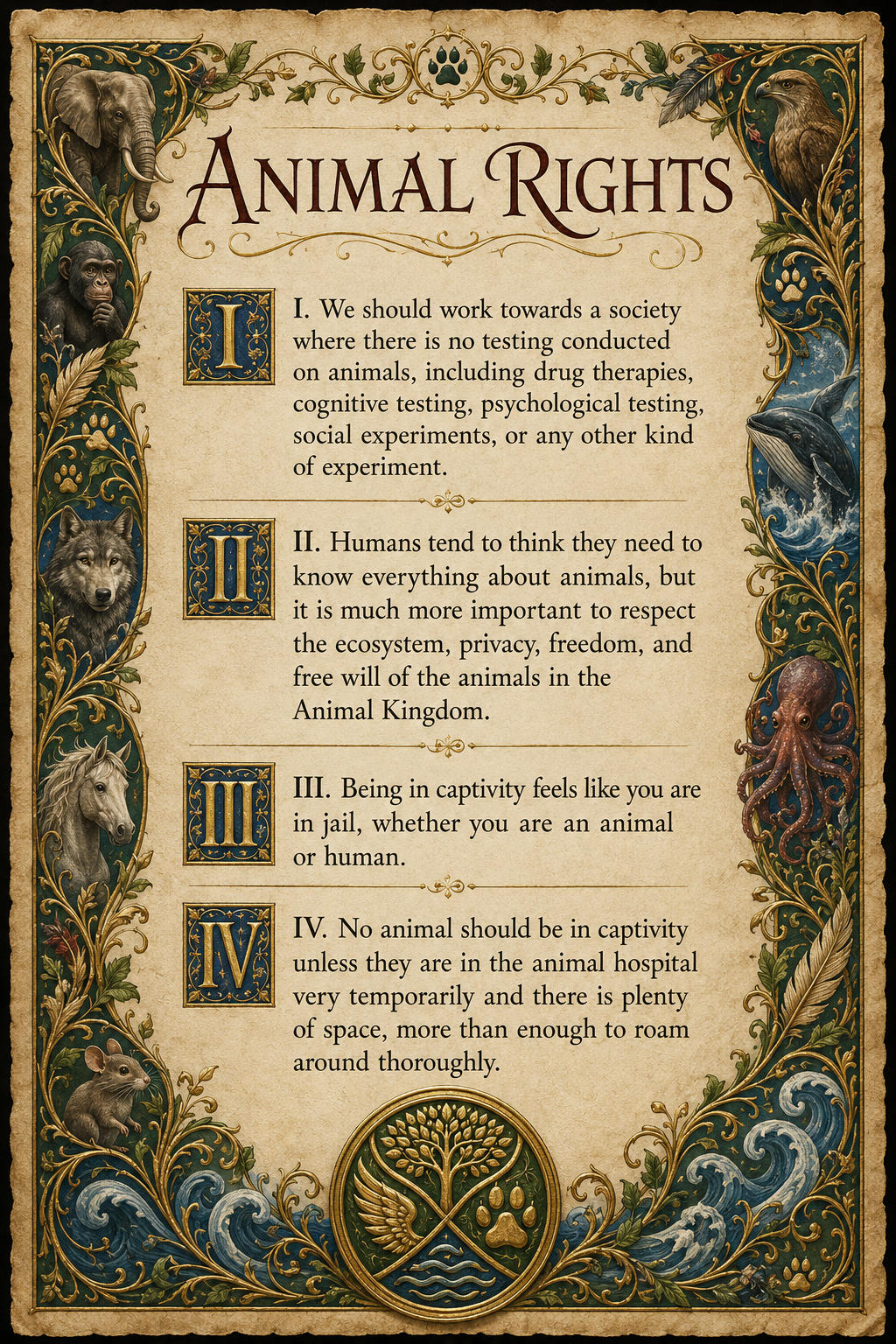
The Animal Constitution
A Condensed Multi-Species Draft
Version 1 • 8/12/2026
Preamble
Animals are not property, experimental materials, entertainment, or environmental background. They are living participants in shared worlds, with their own bodies, relationships, communities, perceptions, needs, and forms of freedom.
These rights belong to animals whether or not humans can understand their language, measure their intelligence, recognize their society, or find them useful. No being should have to become visible, familiar, or humanlike before its life is respected.
“Not understanding an animal’s answer does not constitute consent.”
I. Freedom from Experimentation
Society shall work toward ending all involuntary experimentation upon animals, including drug testing, cognitive testing, psychological testing, social experiments, and other procedures conducted without meaningful consent.
Those proposing to confine, harm, or experiment upon an animal must prove that the action is necessary and that no less harmful alternative exists. The injured being shall not bear the burden of disproving that necessity.
Not understanding an animal’s answer does not constitute consent.
II. Freedom from Captivity
No animal shall be confined for human entertainment, convenience, profit, curiosity, or control.
Temporary restriction may occur when genuinely necessary to provide emergency care, recovery, or protection. It must use the least confining conditions possible, provide more than enough room for movement and species-appropriate activity, and remain directed toward restoring the greatest freedom the animal can safely sustain.
Food, cleanliness, and medical attention do not transform captivity into care when another being continues to control every door.
III. Habitat and the Conditions of Freedom
Freedom requires somewhere to live.
Animals have a right to the habitats, migration routes, food systems, water, air, shelter, and ecological relationships necessary for their lives. An opened enclosure inside a destroyed world is not freedom.
Human societies bear responsibility for restoring conditions damaged through pollution, development, extraction, captivity, breeding, or habitat destruction.
IV. Privacy and Freedom from Uninvited Observation
Animals and animal communities possess a right to privacy.
The ability to observe, record, track, decode, translate, or understand another being does not automatically create the right to do so. Human curiosity is not an animal’s obligation.
Knowledge received from animals or derived from their communication shall not automatically become human property.
V. Bodily and Relational Integrity
Animals possess rights over their own bodies, movement, reproduction, family bonds, social relationships, and species-specific ways of living.
Animals shall not be separated, bred, altered, transported, sold, or killed merely because doing so benefits human institutions.
Animals made dependent through domestication, captivity, injury, biotechnology, or habitat destruction shall not be blamed or abandoned for conditions humans created.
VI. Care Without Exploitation
When an animal faces immediate danger and cannot communicate, others may provide the least harmful care reasonably necessary to protect that animal.
Emergency care does not create permission for experimentation, permanent confinement, ownership, or unrelated research.
Treatment may generate knowledge only when the animal’s welfare remains primary and that knowledge is obtained without withholding care or introducing avoidable harm.
VII. Representation and Participation
Animals must have meaningful representation in decisions affecting their bodies, habitats, movement, survival, communication, and relationships.
No representative may claim that every animal, species, or Kingdom shares one position. Representation must remain accountable to those represented and must preserve disagreement among individuals and communities.
A species is not one mind.
VIII. The Right to Refuse
Animals have the right to refuse contact, observation, participation, confinement, performance, labor, experimentation, and representation.
Refusal must not require human language.
Withdrawal, avoidance, distress, altered movement, silence, and other species-appropriate expressions must be treated as potentially meaningful communication.
No animal must become visible in order to possess rights.
IX. Shared Worlds and Ecological Difference
This Constitution does not treat natural predation as equivalent to human exploitation. Predators, prey, scavengers, pollinators, solitary animals, collective animals, and other forms of life participate in ecological relationships that human law must not simplify into human moral categories.
Human institutions may not justify industrial confinement or killing by comparing those practices to survival within an ecosystem.
Rights must protect both individual beings and the ecological relations through which their lives become possible.
X. Transition, Responsibility, and Review
Known harms should be reduced without waiting for a perfect Constitution.
Where immediate change could create additional suffering, transitions must be specific, transparent, independently reviewed, and directed toward greater freedom. Transition shall never become an excuse for indefinite delay.
Each provision must identify:
- The harm it prevents.
- The freedom or relationship it enables.
- The conditions required to make that freedom real.
- The communities that must participate in its interpretation.
- The party responsible for proving any claimed necessity for restriction.
- The process through which decisions can be challenged and revised.
Constitutional Form
This Constitution shall exist in multiple equally authoritative communicative forms, including written language, image, movement, sound, vibration, spatial pattern, field expression, and other species-appropriate modalities.
The human-language version is one expression of the Constitution. It is not the original against which every other form must be judged.
Foundational Principle
No society should require the threat of war before suffering becomes worthy of negotiation.